Ibn Arabi · Chapter 7 of 10
The In-Between
الْبَرْزَخُ
Dreams and waiting rooms are real places.

Chapter 7 of 10Barzakh and imagination
The isthmus
A barzakh is an in-between, like a strip of land between two seas that touches both but is neither.

Drag the light across.


Why it’s interesting
He says the most important things live in between, not at the extremes.
The hard part
It’s not a place you can point to.
Common misconception
That it only means the time after death. It does include that, but it’s much bigger.
Why it matters
It’s the key that unlocks dreams, visions and imagination.
From the Scholar’s notes3 passages · Arabic, with where to find it
Definition (gap filled)
البرزخ: أمر فاصل بين أمرين بلا تطرف
Fut. I.304 (ch. 63)His own words
Chapter on people's stay in the barzakh
الباب الثالث والستون في معرفة بقاء الناس في البرزخ بين الدنيا والبعث
Fut. I.304 (ch. 63)His own words
Imagination like the barzakh: neither existent nor nonexistent
الخيال كالبرزخ لا موجود ولا معدوم لا معلوم ولا مجهول
Fut. I.304 (ch. 63)His own words
Each line is a short gloss of the passage, not a translation. “His own words” means the Arabic is from Ibn Arabi’s own text at that place.
Three worlds stacked
There’s the world of the body, the world of spirit, and in the middle a real world of imagination where dreams and visions happen.
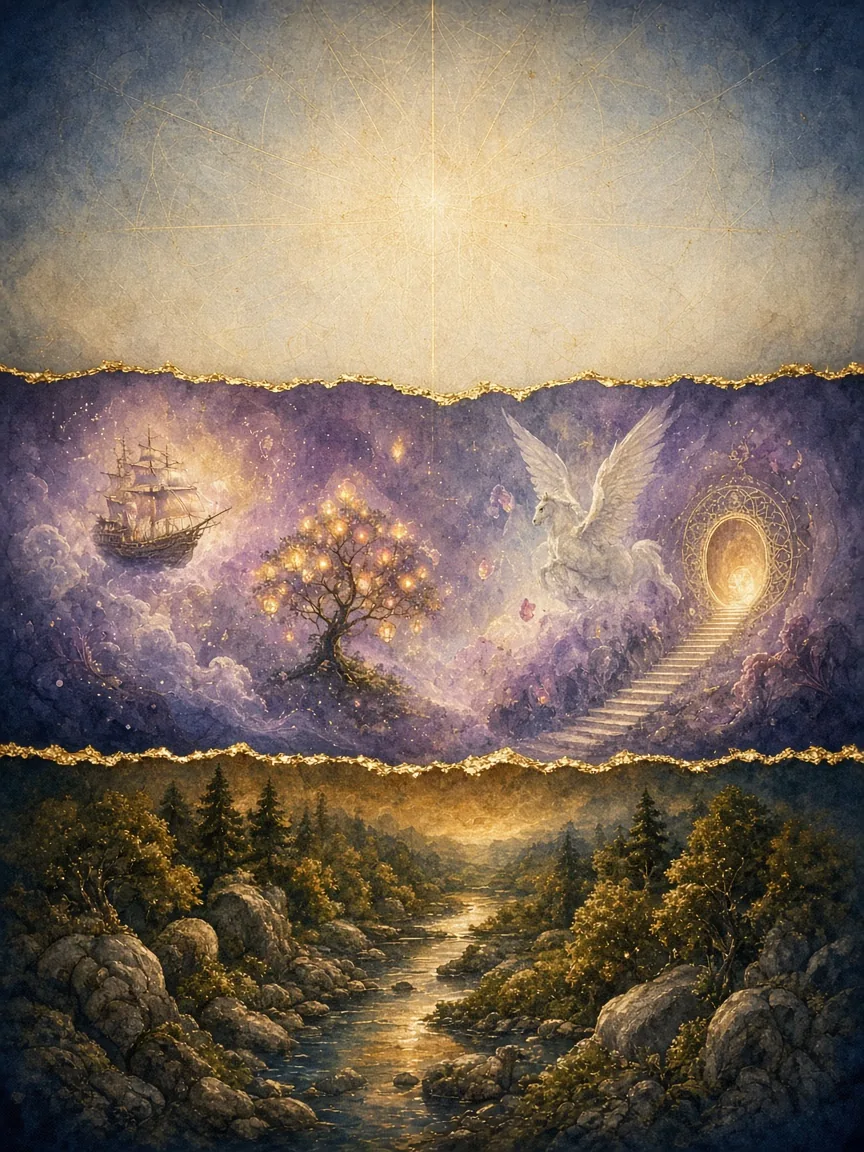
Tap a world, or follow a dream down.
Why it’s interesting
For him, imagination isn’t “made up”. It’s a real place where spirit takes shape.
The hard part
We’re taught imagination equals fake.
Common misconception
That he meant daydreaming.
Why it matters
It’s one of his biggest gifts to thinking about dreams.
From the Scholar’s notes4 passages · Arabic, with where to find it
Connected, detached and absolute imagination (the Cloud)
الخيال المتصل … الخيال المنفصل … الخيال المطلق الذي هو كينونة الحق فيه وهو العماء
Fut. II.310–311 (ch. 177)His own words
Imagination is all real; imagining can be true or false
اعلم أن الخيال حق كله والتخيل منه حق ومنه باطل
Fut. II.113 (ch. 73)His own words
Without imagination we would be nothing
لولا الخيال لكنا اليوم في عدم
Fut. I.304 (ch. 63, opening verse)His own words
"People are asleep; when they die they wake"
الناس نيام فإذا ماتوا انتبهوا
Fut. II.313 (ch. 177); I.207 (ch. 32); I.313His own words use of a saying (hadith status and the ʿAlī attribution not checked) · not every detail confirmed
Each line is a short gloss of the passage, not a translation. “His own words” means the Arabic is from Ibn Arabi’s own text at that place.
Not sea, not land
Where two things meet, there is a place too.
- The big idea
- Between any two things lies an in-between, and it is a real place, with its own weather.
- What’s hard to get
- Real here does not mean physical. It means it has shape and meaning.
- Common misconception
- That imagination is mere make-believe. For him it is where meaning becomes visible.
- Why it matters
- A waiting season, between jobs or before news, can be lived in, not just endured.
The one idea
Stand at the edge of the sea at low tide. The wet sand under your feet is not sea and not land; it is a country of its own, silver and always changing. Ibn Arabi’s word for such a place is برزخ barzakh: what lies between two things and is neither.
His great claim is that imagination, خيال khayāl, is a barzakh. It stands between the world of meaning and the world of things. A dream is not nothing. It is where a meaning puts on a body you can see: fear arrives as a chase down a corridor, grief as an empty house with the lights still on.
Waiting is made the same way. The months between the letter sent and the answer, between the test and the result, are not dead time. They are an in-between, where something is quietly taking shape.
Joseph’s long wait
As a boy, Joseph dreamed that the sun, the moon and eleven stars bowed down to him. Then came the well, the years of service, the prison. Decades of in-between.
At the end his family bowed before him, and he said: this is my old dream, made true. Ibn Arabi carries it one step further. Waking life, too, asks to be interpreted, the way a dream does. We are all, always, reading images.
هَٰذَا تَأْوِيلُ رُؤْيَايَ مِن قَبْلُ قَدْ جَعَلَهَا رَبِّي حَقًّا
“This is the meaning of my dream from before. My Lord has made it true.”
Qurʾān 12:100, Joseph’s words · in plain words
From dream to meaning
A boy’s dream, a well, a prison, and then the answer.

- The big idea
- The years between the dream and its meaning were part of the dream.
- What’s hard to get
- From inside the middle, it looks like nothing is happening.
- Common misconception
- That waiting means you have been forgotten.
- Why it matters
- If you are in a waiting season, you may be in the middle of your story, not outside it.
Try it now
Bring back the last dream you remember, or a daydream from today. Do not ask whether it will come true. Ask what feeling it was giving a shape to, and write that feeling in a single line, for no one but yourself.
Go deeper
6 short sections. Open any one; each stands on its own.
the barzakh is never on one side
1The line between sun and shade1 min
His clearest definition of the barzakh is something you can see on any sunny afternoon:
"Know that the barzakh is something that divides two things and never goes to either side, like the line between shade and sun." (Fut. I.304, ch. 63)
Look for that line on a pavement. It belongs to neither the sun nor the shade, yet it is what lets you tell them apart. He links it to the Qur'an's two seas that meet, "between them a barzakh they do not overstep" (Q 55:19–20). If you feel neither here nor there, between jobs, between cities, between versions of yourself, you are on the line. The line is a real place.
2Your face in the mirror1 min
How can something be neither there nor not there? He points to a mirror:
"Imagination is … neither existent nor nonexistent, neither known nor unknown." (Fut. I.304, ch. 63)
When you see your face in a mirror, you know for certain you saw your face in one sense, and you know for certain you didn't, in another (Fut. I.304; paraphrase). You can't touch it, yet it is plainly you. That is the in-between in miniature: every memory, every dream, every picture of the future you carry around. Not fake. Not solid. Real in their own way, and worth taking seriously.
3Without it we would be nothing1 min
In the middle of this chapter he drops in a short verse that sounds like a love song to imagination:
"If not for imagination, we would be nothing today, and no wish or longing in us would ever be fulfilled." (Fut. I.304, ch. 63)
Everything you have ever wanted first lived in this in-between world, as a picture, before it was anything else. The meal before you cook it, the letter before you write it. Imagination isn't escape. It is the workshop where every next step gets built.
4Imagination is a kind of light1 min
Usually we call light whatever lets the eye see. Ibn Arabi gives that honor to imagination itself:
"Imagination has more right to the name 'light' than every created thing called luminous." (Fut. I.306, ch. 63)
Its light, he says, "reaches into pure nothing and gives it the form of being" (ينفذ في العدم المحض فيصوره وجودا, Fut. I.306). So when people dismiss something as "only imagination", he would answer: the eye of imagination saw correctly. The mistake, if any, lies with the judge who reads it, not with the light (Fut. I.306; paraphrase).
5The chameleon test1 min
How can you tell when you are seeing with the eye of imagination rather than the eye of the senses? He gives a test. If the thing you're looking at keeps changing form, and yet you never doubt it is the same thing,
"like someone watching a chameleon as its colors change," (Fut. I.305, ch. 63)
then you are seeing with imagination. Your feelings about one person can shift from tender to angry in an afternoon, and you still know it's them. That's the chameleon. Knowing this can loosen a hard day: the colors are changing, and the one you love is still there.
6Asleep now, waking later1 min
He gives a saying of the Prophet: "People are asleep, and when they die they wake up" (الناس نيام فإذا ماتوا انتبهوا, Fut. II.313, ch. 177). What we perceive here, he says, is like a sleeper's perceiving. And waking at death is like dreaming that you woke up (Fut. II.313; paraphrase). He even writes: "whoever does not know the rank of imagination has no knowledge at all" (ومن لا يعرف مرتبة الخيال فلا معرفة له جملة واحدة, Fut. II.313).
In the twentieth century, Henry Corbin coined the word imaginal for this world, so no one would mistake it for the merely imaginary.
Key words
Spirit and body, gathered in one person: the complete human.
Next · Chapter 8: The Perfect Human →‹ Chapter 6: New creation at every instant · Course homeSources
- Ibn ʿArabī, al-Futūḥāt al-Makkiyya, ch. 63 and ch. 177 (on imagination and the barzakh)
- Ibn ʿArabī, Fuṣūṣ al-ḥikam; trans. R. W. J. Austin, The Bezels of Wisdom (1980) (the chapter of Joseph)
- William C. Chittick, The Sufi Path of Knowledge (1989), ch. 7–8
- Henry Corbin, Alone with the Alone
- Ibn ʿArabī, al-Futūḥāt al-Makkiyya, ch. 63 (I.304–306), ch. 177 (II.313)
- The Qur'an 23:100; 55:19–20
- Henry Corbin, Alone with the Alone (Creative Imagination in the Ṣūfism of Ibn ʿArabī)
- William C. Chittick, The Sufi Path of Knowledge (1989)