Stress isn’t only a thought. It’s a heartbeat, a jaw, a gut, a breath.
This is education, not a diagnosis.01 · The stress response
Stress is physical
When you sense threat, your whole body gets ready.
The heart speeds up. Muscles tense. Breathing gets quick and shallow. Digestion slows. Stress hormones like adrenaline and cortisol rise.
That’s useful for a sprint. It’s exhausting when it never fully switches off.
02 · Body map
Where it shows up
Stress tends to land in the same places.
The jaw. The shoulders. The gut. The breath.
Noticing where yours lands is useful. The body often notices stress before the mind does.
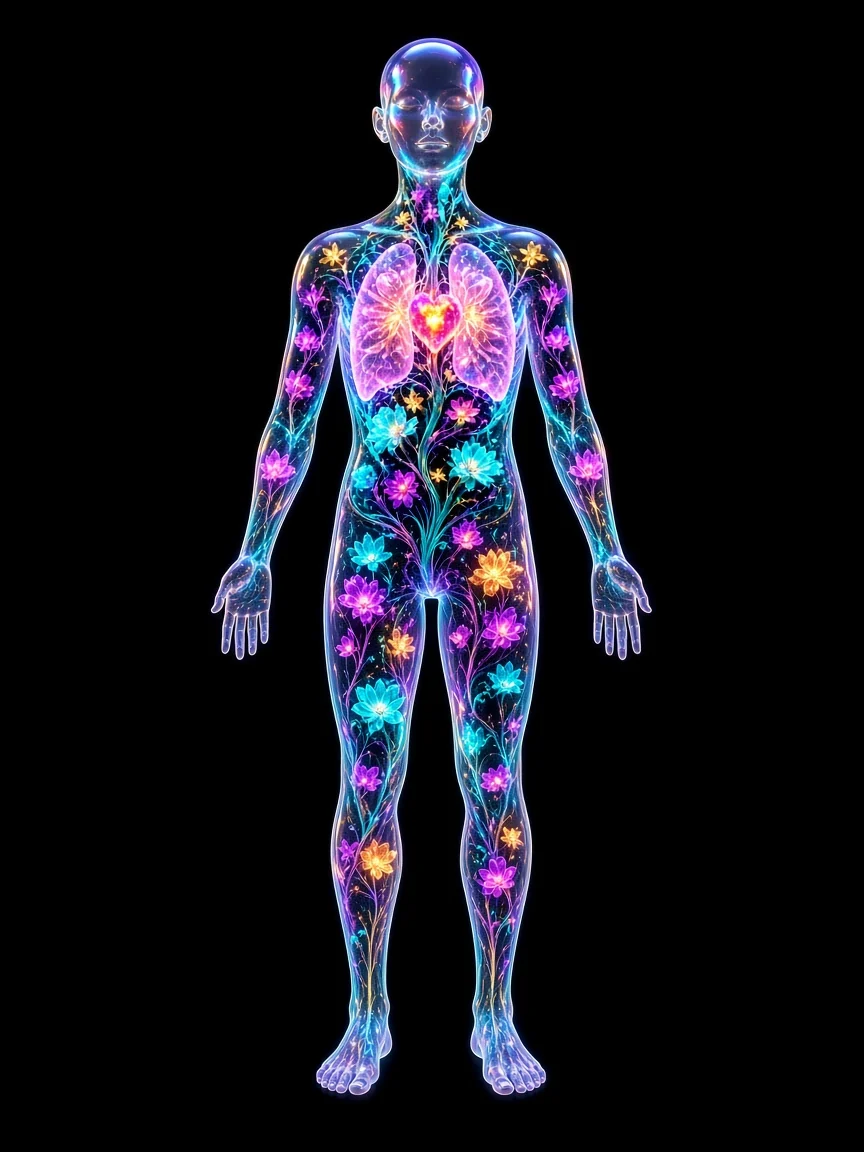
Tap a number to light it up.
03 · Bracing
Stuck braced
The body can stay ready long after the danger is gone.
After long stress or trauma, muscles can stay half-tensed, like a fist you forgot you were making. Shoulders creep up. The jaw stays set.
Over time, that bracing can show up as pain, headaches, tiredness or poor sleep. It’s real. It isn’t “all in your head.”
Try it now: drop your shoulders and unclench your jaw.
04 · The nervous system
An accelerator and a brake
Your body has a gas pedal and a brake.
The autonomic nervous system runs without you thinking about it. One branch (sympathetic) revs you up for action. The other (parasympathetic) slows you down to rest, digest and recover.
After trauma, the accelerator can get sticky, and the brake harder to find. Both can be retrained.
Gas: heart and breath speed up, muscles load, digestion pauses.Brake: heart slows, breath deepens, digestion and repair switch back on.
05 · Polyvagal
One way of describing it: a ladder
Safe, revved up, or shut down.
Polyvagal theory, developed by Stephen Porges, is one way of describing three states the nervous system moves between.
Some of its biology is debated by researchers, but many people find the map useful for noticing where they are. Try the Nervous System Ladder.
Breath is easy. You can think, feel and connect at the same time.Heart racing, jaw tight, restless, irritable or anxious. Energy to act.Heavy, numb, foggy, far away. The body pulling the plug to save energy.
06 · Reminders
The body reacts first
Sometimes the body reacts before the mind knows why.
A body that learned danger can respond to reminders fast: a racing heart at a certain tone of voice, a tight gut in a certain room.
This is learning, not magic. The body is doing what it was trained to do. And it can learn something new.
07 · Settling
Coming back, gently
Bottom-up: calming the mind through the body.
Slow breathing, noticing your feet on the floor, gentle movement, stretching. Small signals of safety, repeated.
Some therapies work with the body directly (see Somatic work). Go slowly. For some people, paying attention to the body feels unsafe at first, and that’s okay.
Your body has been trying to protect you.
If your body has been carrying a lot, we can find ways, slowly and safely, to help it set some of that down.
Therapy, if you want itThis is education, not a diagnosis. Only a qualified professional who knows you can assess what’s going on for you.
Polyvagal theory was developed by Stephen Porges; parts of it are debated. Progressive muscle relaxation (tense and release) comes from Edmund Jacobson.