Ibn Arabi · Chapter 1 of 10
Life and Works
الشيخ الأكبر
from al-Andalus to Damascus
Born in al-Andalus in 1165; died in Damascus in 1240. Between the two lie Seville and Fez, Tunis and Mecca, Konya and Mosul, and thousands of miles on foot and on the swaying backs of caravans. What came to him along the way he called فتوحات futūḥāt, openings, and he wrote them down. Follow the road on the map, then open the two books he is best known for.
Chapter 1 of 10His life and works
The journey map
Ibn Arabi was born in 1165 in al-Andalus, and spent his life traveling across North Africa, Mecca and Anatolia before settling in Damascus, where he died in 1240.
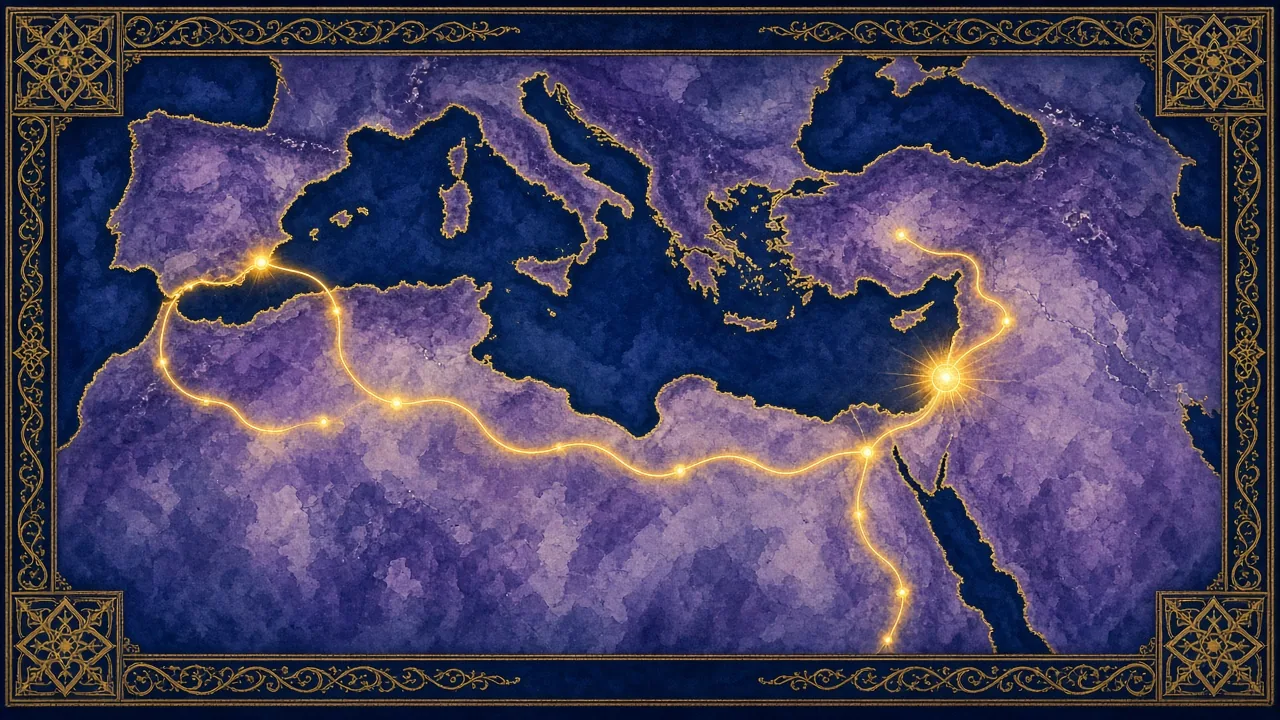
Press play, or tap a city.


Why it’s interesting
He met hundreds of teachers along the way, including women saints, and many of his big insights came during the travels.

The hard part
Places and dates blur together, so the map makes the arc easy to see.

Common misconception
That he was a hermit. He was very social, always meeting people and writing.

Why it matters
It shows his ideas came from a lifetime of moving between worlds.
From the Scholar’s notes5 passages · Arabic, with where to find it
Met Ibn Rushd as a youth: "yes… no"
قلت له نعم … لا، وبين نعم ولا تطير الأرواح من موادها والأعناق من أجسادها
Fut. I.153–154 (ch. 15)His own words (no year in text)
Served Fāṭima bint Ibn al-Muthannā in Seville
امرأة … باشبيلية يقال لها فاطمة بنت ابن المثنى القرطبي خدمتها سنين
Fut. II.347 (ch. 178); I.274 (وهي بنت خمس وتسعين سنة)His own words
Told in Marrakesh to take al-Ḥaṣṣār of Fez east
محمد الحصار بمدينة فاس … فخذه معك
Fut. II.436 (ch. 198)His own words
Mecca 599 dream: Kaʿba of silver and gold bricks, two missing, he fills them
الكعبة مبنية بلبن فضة وذهب … فرأيت نفسي قد انطبعت في موضع تلك اللبنتين
Fut. I.318–319 (ch. 65)His own words
Khiḍr's mantle via ʿAlī b. Jāmiʿ, Mosul
يسكن بالمقلى خارج الموصل … وكان الخضر قد ألبسه الخرقة … وألبسنيها
Fut. I.187 (ch. 25)His own words (year not on page)
Each line is a short gloss of the passage, not a translation. “His own words” means the Arabic is from Ibn Arabi’s own text at that place.
The Futūḥāt spiral
His biggest book, The Meccan Openings, has 560 chapters, and each glowing dot is one of them.

Drag along the spiral, or tap a ringed chapter.

Why it’s interesting
He said he wrote much of it as it was “opened” to him, not by planning it out.
The hard part
It’s enormous and jumps between topics, so people get lost.
Common misconception
That you read it front to back. Most people dip into chapters.
Why it matters
Almost every later idea in this course comes from this book.
From the Scholar’s notes5 passages · Arabic, with where to find it
Futūḥāt finished, Wednesday 24 Rabīʿ I 636
وكان الفراغ من هذا الباب الذي هو خاتمة الكتاب … سنة ست وثلاثين وستمائة
Fut. IV.553 (ch. 560)His own words
Chapter on people's stay in the barzakh
الباب الثالث والستون في معرفة بقاء الناس في البرزخ بين الدنيا والبعث
Fut. I.304 (ch. 63)His own words
Chapter on love
الباب الثامن والسبعون ومائة في معرفة مقام المحبة
Fut. II.320ff (ch. 178)His own words
Chapter on the Breath (nafas)
الباب الثامن والتسعون ومائة في معرفة النفس بفتح الفاء
Fut. II.390ff (ch. 198)His own words
Chapter on the beautiful names
الباب الثامن والخمسون وخمسمائة في معرفة الأسماء الحسنى
Fut. IV.196ff (ch. 558)His own words
Each line is a short gloss of the passage, not a translation. “His own words” means the Arabic is from Ibn Arabi’s own text at that place.
The Fuṣūṣ ring
His short book, The Bezels of Wisdom, has 27 chapters, each one a “gem” tied to a prophet.
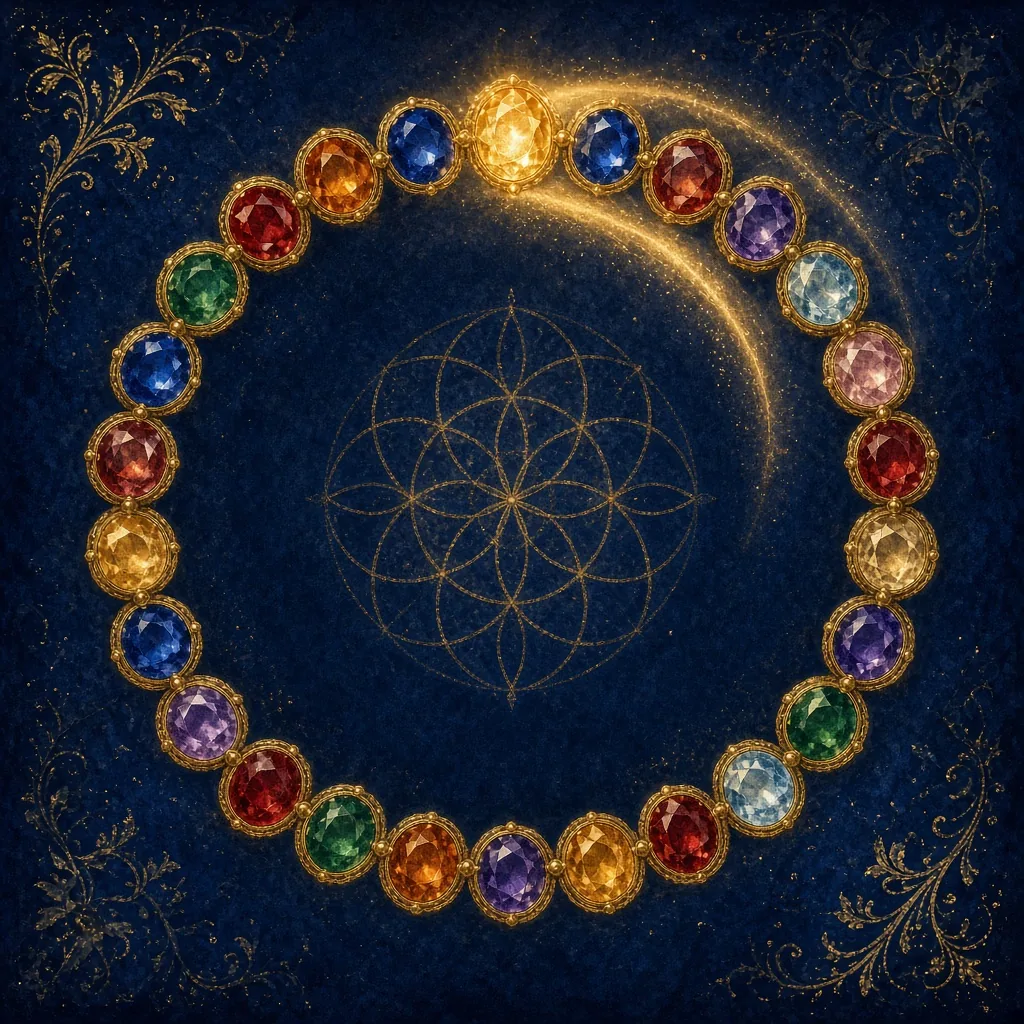
Tap a gem.
Why it’s interesting
Each prophet is shown as a setting that holds one special kind of wisdom.
The hard part
It’s dense and poetic, and every line hides layers.
Common misconception
That it’s a history of the prophets. It’s really about the inner meaning each one carries.
Why it matters
It’s his most read and most argued-over book.
From the Scholar’s notes3 passages · Arabic, with where to find it
Fuṣūṣ handed to him whole, nothing added
كما حده لي رسول الله … من غير زيادة ولا نقصان
Fus. 47 (khuṭba)His own words (date line unreadable in digital copy)
The bezel list in his own words
حكمة إلهية في كلمة آدمية، وهو هذا الباب. ثم حكمة نفثية …
Fus. 57–58 (end of Ādam)His own words
Each bezel's wisdom matched to a divine quality
structure of the bookHis own words structure; the reasoning for each match comes from the commentators (al-Qāshānī, al-Qayṣarī, Jāmī) · not every detail confirmed
Each line is a short gloss of the passage, not a translation. “His own words” means the Arabic is from Ibn Arabi’s own text at that place.
The road east
Press play. The line is his road, city by city.
the West الغربthe East المشرق
- The big idea
- One long road, from the far west of the old world to Damascus. The outer trip and the inner one moved together.
- What’s hard to get
- The moves weren’t random. A new city often came with a new opening inside him.
- Common misconception
- That a spiritual life means sitting still. Much of his happened on the road.
- Why it matters
- When life moves you somewhere you didn’t plan, it can still be your road.
The two great books
Each dot is one chapter of the Futūḥāt, in the order of the book. Tap a dot, a section, or switch to the Fuṣūṣ.
- The big idea
- Two books matter most: a huge one, the Openings, and a short one, the Ringstones, with one wisdom for each prophet.
- What’s hard to get
- The big one isn’t meant to be read front to back. You go in anywhere.
- Common misconception
- That the long book says more. The short one holds the same vision, packed tight.
- Why it matters
- You don’t need all of it. One idea is enough for one day.
Go deeper
His nameمُحْيِي الدِّين ابن عربي
His given name was Muḥammad. Muḥyī al-Dīn, Reviver of the Way, was a title. al-Ḥātimī al-Ṭāʾī ties him to the tribe of Ṭayy, the people of Ḥātim al-Ṭāʾī, whose generosity was proverbial. Everyone who came after calls him الشيخ الأكبر al-Shaykh al-Akbar, the Greatest Master.
Six names, one man
A full Arabic name is a little biography. Tap a name to see what it tells.
- The big idea
- A full Arabic name is a short biography: title, given name, family line, and the name people used.
- What’s hard to get
- Each part answers a different question about who he was.
- Common misconception
- That a name is just a label. Every part of this one tells you something.
- Why it matters
- You’re more than one label too: your work, your people and what you love all count.
The West: al-Andalus and North Africaالأندلس والمغرب 1165–1201
He grew up in Seville, the son of a man in government service, and at first he lived like one: the court, the hunt, the company of friends. Around twenty he turned toward the path. His teachers were plain and serious people. Two of them were women: Fāṭima bint Ibn al-Muthannā, very old, who taught him in Seville and called him her spiritual son, and Shams of Marchena.
The finest story is his meeting with the philosopher Ibn Rushd. The great man asked the young one whether what is seen from the inside, كشف kashf, matches what reason finds. He said: yes, and no. Between the yes and the no, he added, spirits fly out of their matter. Years later he watched Ibn Rushd’s coffin carried home on a mule, balanced on the other flank by the dead man’s own books.
The Sealخَتْم الوِلاية khatm al-walāya
ولاية walāya means friendship with the Real, nearness. In Mecca he dreamed of the Kaaba built of silver and gold bricks, whole except for two missing bricks, and he saw himself set into the gap. He read it as a calling: to bring the inner inheritance of the Prophet to completion, the way the last bricks make a wall whole.
Two missing bricks
His dream in Mecca, drawn plainly. Tap the gap.
- The big idea
- He dreamed of the Kaaba built of silver and gold bricks, with two missing, and saw himself fill the gap.
- What’s hard to get
- The point is completion, not pride. The Kaaba was nearly whole.
- Common misconception
- That the last brick matters most. Every brick holds the building up.
- Why it matters
- On a day you feel small, the building still needs every brick, including you.
The East: Mecca to Damascusالمشرق 1201–1240
He left the West at about thirty-six and never returned. In Mecca he started his huge book, and met Niẓām, his host’s learned daughter, who became for him the very picture of beauty and wisdom. His love poems are full of her light.
Then twenty years on the move: Mosul, Konya, Malatya, Aleppo. In Konya he took on a young student, Ṣadr al-Dīn al-Qūnawī, who would carry his teaching forward. From 1223 he lived in Damascus, among friends and students who read his books aloud with him. He died there in 1240 and is buried on the slope of Mount Qāsiyūn.
al-Futūḥāt al-Makkiyyaالفُتُوحَات المَكِّيَّة The Meccan Openings
Futūḥ means openings: things that open in you, rather than things you work out. He started it in Mecca in 1202 and kept going for over thirty years. It ended up as 560 chapters.
It is less a book than a city: metaphysics and letters, the Names, the inner meaning of every practice, his dreams and his poems. You do not read it from front to back. You walk in by some gate and look around.
A life of writing
Where he lived on the left, what he wrote on the right, year by year. Tap a book.
- The big idea
- He wrote his whole life, from his twenties in the West to his last years in Damascus.
- What’s hard to get
- Some books came in days. His biggest took more than thirty years.
- Common misconception
- That big work arrives all at once.
- Why it matters
- Slow work is still work. A little each day adds up.
Fuṣūṣ al-ḥikamفُصُوص الحِكَم The Ringstones of Wisdom
A faṣṣ is the setting of a ring, where the stone sits. Twenty-seven chapters, each setting one wisdom in one prophet: Adam, Noah, Abraham, Joseph, Jesus, Muḥammad and others. It came in Damascus in 1229, in a vision, he says, and he passed it on as given.
If the Futūḥāt is a city, the Fuṣūṣ is a jewel box: short, dense, the most read of all his books. Several chapters in this course start from it.
How he wroteالفَتْح والإلقاء opening and casting
He says his books arrived rather than being planned: an opening, فتح fatḥ, something cast into the heart, إلقاء ilqāʾ. He wrote what came, in the order it came. That is why his writing circles back to the same themes from new angles, like a river returning past the same hills. Under all of it sits one source he never stops reading: the Qurʾān.
Opened, not built
Two ways a book can come into the world. Tap a side.
- The big idea
- He experienced his books as opened to him, not built from a plan.
- What’s hard to get
- Receiving still takes work: staying open, and writing it down.
- Common misconception
- That inspiration means doing nothing. It takes attention.
- Why it matters
- When you’re stuck, stepping back can let the next idea land.
Go deeper
7 short sections. Open any one; each stands on its own.
tap a place to open its story
1Fāṭima, who served by the Opening1 min
In Seville he served an old woman, Fāṭima bint Ibn al-Muthannā, for years. She was ninety-five, and her cheeks were so rosy you'd take her for fourteen. She preferred him to her other helpers, and said why:
"When he comes in to me, he comes in with all of himself, leaving nothing of himself outside." (Fut. II.347, ch. 178)
She told him the Real had given her al-Fātiḥa, the Opening of the Qur'an, as a servant, and "it never distracted me from Him" (فوالله ما شغلتني عنه, Fut. II.347). For a scattered mind, her praise is a quiet instruction: arrive with all of yourself, then leave with all of yourself.
2The women he counted truest1 min
He was plain about who had taught him most. In one list of people who reached a rare station, he writes that the truest he saw among women were Fāṭima bint Ibn al-Muthannā in Seville; Shams, "Mother of the Poor", in Marchena; Umm al-Zahrāʾ, also in Seville; and Kalbahār in Mecca, whom people called Sitt Ghazāla, "Lady Gazelle" (Fut. I.274, ch. 51; paraphrase). Four names, four towns, set down in his biggest book. His path was shaped by women as much as by men, and he wanted that remembered.
3A thin veil, and a coffin1 min
After the "yes" and "no" meeting with Ibn Rushd, Ibn Arabi wanted to see him once more. Instead, in a vision, he saw him behind a fine curtain:
"A thin veil was set between us. I could see him through it, and he could not see me." (Fut. I.154, ch. 15)
He took it as a sign that Ibn Rushd was not meant for the road he himself was on, and they did not meet again before Ibn Rushd died (Fut. I.154; paraphrase). Years later he watched the coffin leave for Córdoba, balanced on the mount by Ibn Rushd's books, and wrote a line: "Here is the master, and these his works. If only I knew: did his hopes reach him?" (هذا الإمام وهذه أعماله، يا ليت شعري هل أتت آماله, Fut. I.154).
4The bird from Fez1 min
In Marrakesh he had a vision of the great Throne. Among the lovely birds flying in its corners, one greeted him, and he was told: this is Muḥammad al-Ḥaṣṣār of Fez, who has asked to travel east; take him with you. In Fez he looked the man up and asked whether he had asked for anything. Al-Ḥaṣṣār said:
"Yes. I asked to be carried to the lands of the East, and was told, 'So-and-so will carry you.' I have been waiting for you ever since." (Fut. II.436, ch. 198)
They set out together in 597 (1200–1201). Al-Ḥaṣṣār died in Egypt. Sometimes the person you meet has been waiting for you.
5A mantle in a garden1 min
Outside Mosul, in a garden at al-Muqlā, lived ʿAlī ibn ʿAbd Allāh ibn Jāmiʿ. Khiḍr, the green guide of the Qur'an's story of Moses, had once given him the Sufi mantle, the khirqa, in that garden. Ibn Jāmiʿ gave it to Ibn Arabi in the same spot, in the same way (Fut. I.187, ch. 25; paraphrase). From then on he gave the mantle to others too. But he says what it really means:
"For us, the mantle simply means companionship, courtesy and taking on good character." (Fut. I.187, ch. 25)
A piece of cloth, standing for how you keep company.
6A translator, not a ruler1 min
The Fuṣūṣ came in a dream in Damascus, late in Muḥarram 627 (December 1229). The Prophet held out a book: "This is the book of the Bezels of Wisdom. Take it and bring it out to people, so they may benefit from it" (Fus. 47; paraphrase of the opening). Ibn Arabi describes his prayer as he began:
"So that I might be a translator, not one who imposes." (Fus. 47, preface)
A beautiful way to work at anything: carry it across with care, without forcing your own stamp on it.
7In his own hand1 min
The Futūḥāt took him more than thirty years. At its very end he wrote that this was the second copy, in his own handwriting, finished "early on the morning of Wednesday, the twenty-fourth of Rabīʿ al-Awwal, 636" (autumn 1238), and signed it: Muḥammad ibn ʿAlī ibn Muḥammad ibn al-ʿArabī al-Ṭāʾī al-Ḥātimī (Fut. IV.553, ch. 560). Two years later, in 1240, he died in Damascus and was buried on the slope of Mount Qāsiyūn, where people still come to sit by him.
One man, one long road. Now the idea everyone links to his name: one light, many windows.
Next · Chapter 2: Oneness of being →‹ Chapter 10: The heart that takes every form · Course homeSources
- Claude Addas, Quest for the Red Sulphur: The Life of Ibn ʿArabī, trans. Peter Kingsley (1993)
- Stephen Hirtenstein, The Unlimited Mercifier: The Spiritual Life and Thought of Ibn ʿArabī (1999)
- R. W. J. Austin, Sufis of Andalusia (1971), from the Rūḥ al-quds and al-Durra al-fākhira
- Michel Chodkiewicz, Seal of the Saints (1993)
- William C. Chittick, The Sufi Path of Knowledge (1989)
- Henry Corbin, Alone with the Alone: Creative Imagination in the Sūfism of Ibn ʿArabī
- Ibn ʿArabī, al-Futūḥāt al-Makkiyya; Fuṣūṣ al-ḥikam, ed. A. E. ʿAfīfī (1946); The Bezels of Wisdom, trans. R. W. J. Austin (1980)
- Ibn ʿArabī, al-Futūḥāt al-Makkiyya, ch. 15 (I.153–154), ch. 25 (I.187), ch. 51 (I.274), ch. 178 (II.347), ch. 198 (II.436), ch. 560 (IV.553)
- Ibn ʿArabī, Fuṣūṣ al-ḥikam, ed. Afifi, preface (p. 47)
- Claude Addas, Quest for the Red Sulphur (1993)
- Ibn ʿArabī, Sufis of Andalusia (Rūḥ al-quds), tr. R. W. J. Austin
A road walked, a world written down.