Ibn Arabi · Chapter 3 of 10
The Ninety-Nine Names
الأسماء الحسنى
al-asmāʾ al-ḥusnā · the most beautiful names
Chapter 3 of 10The Names
The constellation of Names
The divine Names, like the Merciful, the Gentle and the Majestic, aren’t just titles. For him they’re active forces, grouped into families like mercy, majesty and beauty.
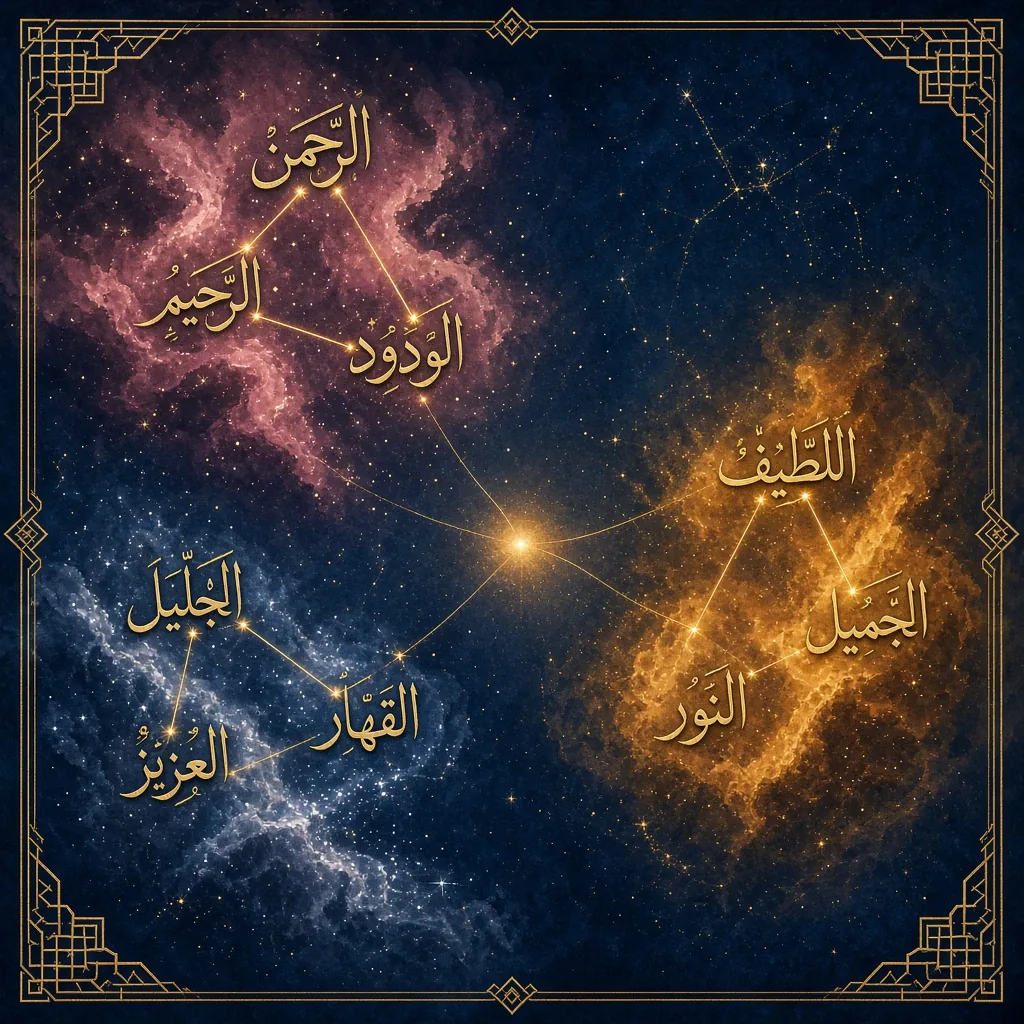
Tap a Name, or a family.
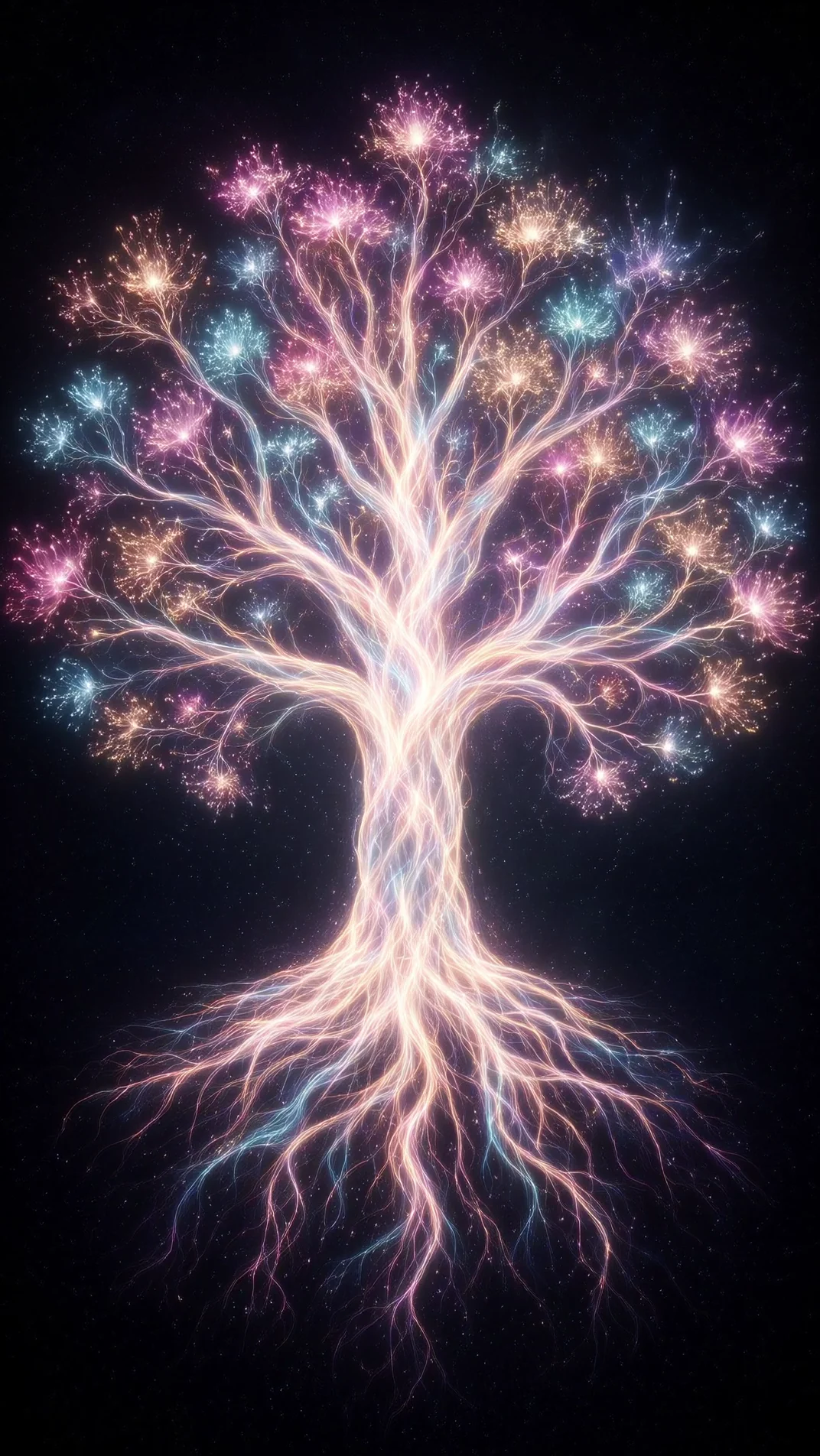

Why it’s interesting
He treats them like a living web where some Names lean on others.
The hard part
A “Name” here means something more like a quality in action than a label.

Common misconception
That they’re just a list to memorize.

Why it matters
In his view, the whole universe is these Names showing themselves.
From the Scholar’s notes4 passages · Arabic, with where to find it
The beautiful names, past counting, wanted to see their entities
لما شاء الحق سبحانه من حيث أسماؤه الحسنى التي لا يبلغها الإحصاء أن يرى أعيانها
Fus. 48 (Ādam)His own words
Majesty and beauty are essential
الجلال والجمال لله وصف ذاتي
Fut. II.114 (ch. 73)His own words
The path is built on taking on the names
مبنى هذا الطريق على التخلق بأسماء الله
Fut. II.42 (ch. 73)His own words
Taking on the divine traits is Sufism
فالتخلق بأخلاق الله هو التصوف
Fut. II.267 (ch. 165)His own words
Each line is a short gloss of the passage, not a translation. “His own words” means the Arabic is from Ibn Arabi’s own text at that place.
Names in the world
Every thing you see shows certain Names. Water shows gentleness, the night sky shows majesty.
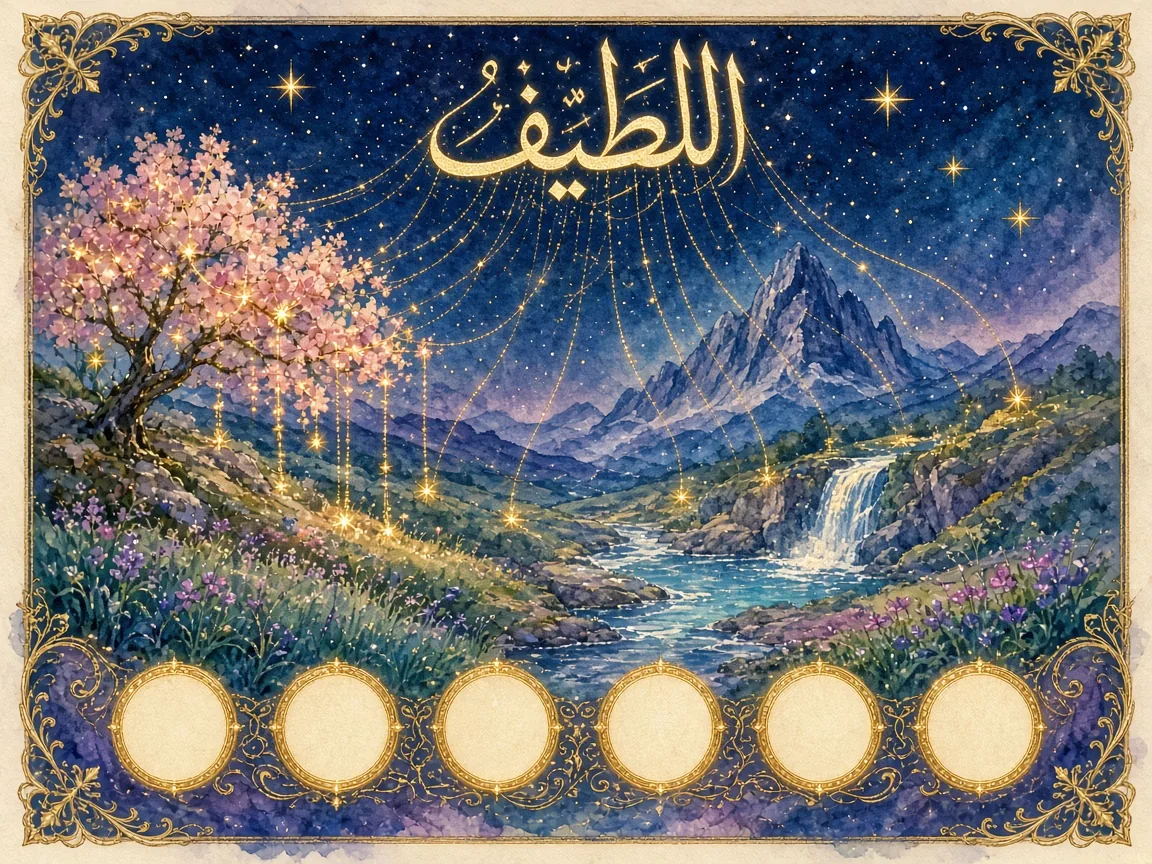
Tap something in the picture.
Why it’s interesting
It turns the world into something you can “read”.
The hard part
One thing shows many Names at once, never just one.
Common misconception
That bad things show no Names. He’d say even hardship shows some quality, like majesty or wisdom.
Why it matters
It gives you a way to notice the sacred in everyday things.
From the Scholar’s notes3 passages · Arabic, with where to find it
All being is words that never run out
العارفون بالله عندهم الوجود كله كلمات الله لا تنفد أبدا
Fut. I.436 (ch. 69); cf. I.366His own words
Mercy spans everything (al-Raḥmān, al-Ḍārr read within mercy)
رحمة الله وسعت كل شيء وجودا وحكما
Fus. 177 (Zakariyyā)His own words
Guard yourself in taking on the names
فاحفظ يا ولي نفسك في التخلق بأسماء الله الحسنى
Fut. I.231His own words
Each line is a short gloss of the passage, not a translation. “His own words” means the Arabic is from Ibn Arabi’s own text at that place.
For Ibn Arabi, everything you see is a name of the Real, showing itself. A river shows the Living; a mother’s patience shows the Forbearing; the night sky shows the Vast. Each person carries a particular weave of names, bright in some threads and faint in others, and that weave is part of who you are. To grow, in his teaching, is to take on the qualities of the names, التخلّق takhalluq, until you are a little more merciful, patient, generous and wise. And the ninety-nine are a doorway, not a fence: the names, he says, are as many as the things in the world.
On a stressful day
When a day goes badly, the whole world can shrink to the size of one problem. The names open it out again. Choose the one that matches what you are missing, the Opener when you feel stuck, the Patient when everything is slow, the Most Tender when you are being hard on yourself, and read its card. It takes less than a minute, and it reminds you that the quality you need is already at large in the world, and some of it already lives in you.
The map of the Names
Tap a name to open its card. On a phone, tap a family first to look closer.
The name at the center, اللّٰه, gathers all the others. The names of mercy and beauty, جمال jamāl, sit at the top; the names of majesty and power, جلال jalāl, sit at the bottom, because Ibn Arabi sees the whole world swinging between these two. Each family reads outward from the center.
All ninety-nine, family by family
The same names as the map, as a list. Tap any one.
The center المركزthe name that holds the rest
Mercy and Love الرحمة والمحبة13 names
Light and Peace النور والسلام9 names
Giving and Opening العطاء والفتح9 names
Making and Life الخلق والحياة11 names
Knowing and Seeing العلم والشهود9 names
Guarding and Nearness الحفظ والقرب7 names
Balance and Turning العدل والتقليب13 names
Majesty and Power الجلال والقدرة16 names
Oneness and Time الوحدة والدوام11 names
Go deeper
Why ninety-nine, and why moreالأسماء لا تتناهى the names have no end
Ibn Arabi teaches that the beautiful Names are beyond counting. The 99 are a doorway into them.
Every single thing, he says, is a word spoken by the Real, and each word shows a name. So the names are as many as the things in the world, and they never repeat: the Real’s self-disclosure never repeats, لا تكرار في التجلّي, and is never the same way twice.
Beauty and majestyجمال jamāl · جلال jalāl
Ibn Arabi sorts the names into two great kinds. The names of beauty draw near: mercy, gentleness, love. The names of majesty make you step back: power, greatness, awe. Most things show both, like the ocean, which is lovely and terrifying at once.
He also notices that mercy comes first. Mercy is the wider circle, and even the hard names sit inside it, the way the map here puts every family inside one painted round.
Taking on the namesالتخلّق بالأسماء takhalluq
A person, for Ibn Arabi, is a small copy of the whole, with every name inside in some measure. Most of them sleep. The path is to wake them: to let the Patient show a little more in your patience, the Generous in your giving, the Just in how you treat people.
He calls the one in whom all the names are awake and in balance الإنسان الكامل al-insān al-kāmil, the complete human, the subject of Chapter 8. Nobody is asked to finish that work in a day. One name, practiced for one afternoon, already counts.
Go deeper
6 short sections. Open any one; each stands on its own.
1Whatever you need is a Name1 min
His chapter on the Names (ch. 558) opens with a startling rule. He reads the verse "O people, you are the needy ones, in need of the Real" (Q 35:15) and draws this from it:
"Everything that is needed is a name of the Real, since there is no need except for Him." (Fut. IV.196, ch. 558)
So your need is not a failure. It is a pointer. Needing peace points to al-Salām, Peace. Needing someone to listen points to al-Samīʿ, the Hearing. Needing a way out points to al-Fattāḥ, the Opener. Each need, followed all the way down, ends at a Name.
2We are the Names1 min
The same chapter begins with a short poem. It pictures the Names as a ladder that "rises and falls", blown by winds from the south and the north (أرى سلم الأسماء يعلو ويسفل). Then comes a line that turns the whole thing inward:
"Our very selves are His names, nothing else." (Fut. IV.196, ch. 558)
You don't only call on the Names. In his picture, you are one of the ways a Name shows itself. A patient person is patience appearing. A generous friend is generosity with a face. When you notice a quality in someone, you are, in his language, seeing a Name walk across the room.
3The first Name to act: the Giver1 min
Asked which Name came first in shaping things, Ibn Arabi answers without hesitating:
"al-Wahhāb, the Giver, is the first Name whose trace appeared in the fixed entities." (Fut. II.57, ch. 73)
Before you were anything, you were given to. The first touch of the Real on what would become you was a gift: not a test, not a demand. وهّاب wahhāb is an intense form: not "one who gives" but "one who gives and gives". When the day feels like one long demand, it can help to remember that the first word spoken over you was here, take this.
4Every Name is every other, and not1 min
In the Fuṣūṣ, right after the green glass, Ibn Arabi asks a playful question: "Where is the Forgiving, compared with the Outward and the Inward? Where is the First, compared with the Last?" (فأين الغفور من الظاهر ومن الباطن، وأين الأول من الآخر, Fus. 104, Yūsuf). Each Name has its own work. And yet:
"So it has become clear to you how each Name is the very other Name, and how it is other than it." (Fus. 104, Yūsuf)
Think of one person being a parent, a colleague and a friend: three ways of being present, one person. On a hard day the Real might meet you as the Strong or as the Gentle. It is the same Real.
5Every state is a sentence1 min
Ibn Arabi notices that things speak even when silent. A wilted plant says "water". A slumped friend says "I'm tired". He puts it plainly:
"There is no tongue more eloquent than the tongue of states." (Fut. I.436, ch. 69)
And for those who know, "all of existence is words of the Real that never run out" (الوجود كله كلمات الله لا تنفد أبدا, Fut. I.436). Your mood this morning, the weather, the traffic: each is a word in that endless speaking. Learning the Names is learning to read the sentence your day is writing.
6Holding what you are given1 min
Ibn Arabi gives the whole path a one-line definition: "taking on the character traits of the Real is Sufism" (فالتخلق بأخلاق الله هو التصوف, Fut. II.267, ch. 165). He sets it inside the Qur'an's image of the trust, الأمانة al-amāna (Q 33:72). Everything around you, he says, is placed in your hands as a trust, so that you give each thing its due, as the Real "gave each thing its making" (Q 20:50). If you carry it well, you are the Sufi (Fut. II.267, ch. 165; paraphrase).
Sufi teachers after him kept this phrase, taking on the Names, as one of the plainest ways to say what the whole path is.
Key words
Names need something to show them. Before anything exists, it is already known.
Next · Chapter 4: Fixed essences →‹ Chapter 2: Oneness of being · Course homeSources
- Ṣaḥīḥ al-Bukhārī and صحيح مسلم: the saying that there are ninety-nine names
- al-Tirmidhī, al-Jāmiʿ, Book of Supplications, no. 3507: the list and its order
- Edward William Lane, An Arabic-English Lexicon (1863–93): roots and their first meanings
- The Quranic Arabic Corpus, University of Leeds (corpus.quran.com): root index
- al-Ghazālī, al-Maqṣad al-asnā; trans. David Burrell and Nazih Daher (1992)
- William C. Chittick, The Sufi Path of Knowledge (1989), on the names and their self-disclosure
- Ibn ʿArabī, al-Futūḥāt al-Makkiyya, ch. 558, on the Most Beautiful Names
- Ibn ʿArabī, al-Futūḥāt al-Makkiyya and Fuṣūṣ al-ḥikam
- Ibn ʿArabī, al-Futūḥāt al-Makkiyya, ch. 558 (IV.196), ch. 73 (II.57), ch. 69 (I.436), ch. 165 (II.267)
- Ibn ʿArabī, Fuṣūṣ al-ḥikam, ed. Afifi, Yūsuf (p. 104)
- The Qur'an 20:50; 33:72; 35:15
- William C. Chittick, The Sufi Path of Knowledge (1989)
Every thing is a name, showing itself.