Ibn Arabi · Chapter 8 · a closer look
Know Yourself
مَنْ عَرَفَ نَفْسَهُ
Your shape is the window the light chose.

A closer look, inside Chapter 8 · The Perfect Human. Start there for the painted concepts; this page goes further.
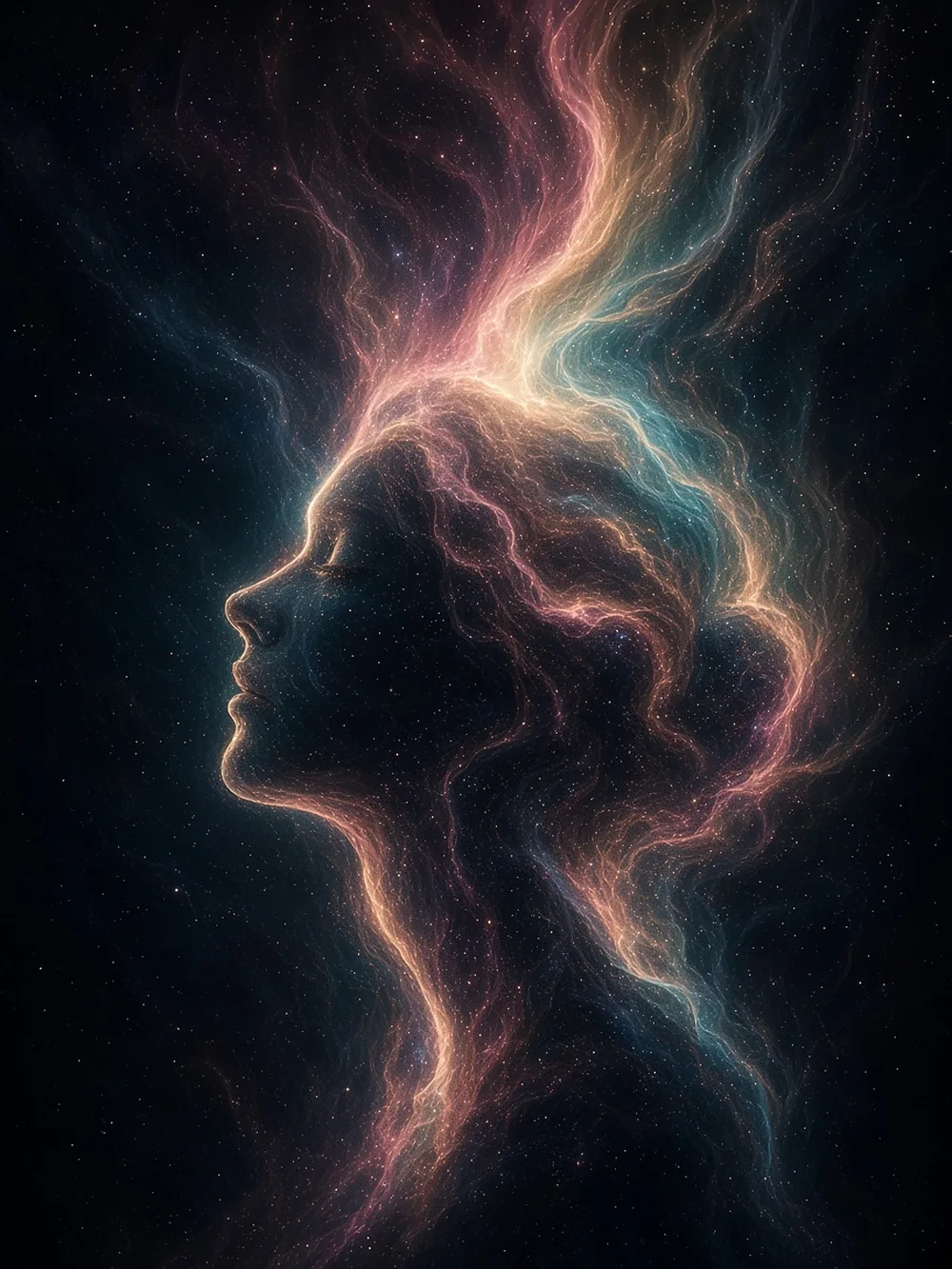
A mirror, polished
A human being: where the world gets to see itself clearly.
- The big idea
- Knowing yourself, truly and kindly, is a way of knowing the Real.
- What’s hard to get
- This is not self-improvement. It begins with seeing what is already there.
- Common misconception
- That the Complete Human means flawless, or above other people. It means whole.
- Why it matters
- You can stop fighting your own grain and begin to work with it, the way a carver follows the wood.
The one idea
Ibn Arabi returns again and again to one line: whoever knows themself knows their Lord. He means it plainly. Knowing yourself is not a detour from the Real. It is the road.
Here is why. Every thing has a shape it was known in before it ever existed. He calls it العين الثابتة al-ʿayn al-thābita, the fixed essence: your particular grain, what you notice, what you love, where you are tender. It comes with a readiness, استعداد istiʿdād, that decides how the light comes through you.
So the work is not to become someone else. It is to know your own shape, truly and kindly. A therapist would call that insight. He would call it learning the window through which the Real chose to look.
مَنْ عَرَفَ نَفْسَهُ عَرَفَ رَبَّهُ
“Whoever knows themself knows their Lord.”
A saying he returns to throughout Fuṣūṣ al-ḥikam and al-Futūḥāt
Adam
The Fuṣūṣ opens with Adam. Ibn Arabi pictures the world as a mirror already made but not yet polished, its surface clouded. Adam was the polish. In a human being, the whole picture at last comes clear.
This is his الإنسان الكامل al-insān al-kāmil, the Complete Human. Not flawless, but complete: one life with room for patience and fire, tenderness and strength.

Your own shape
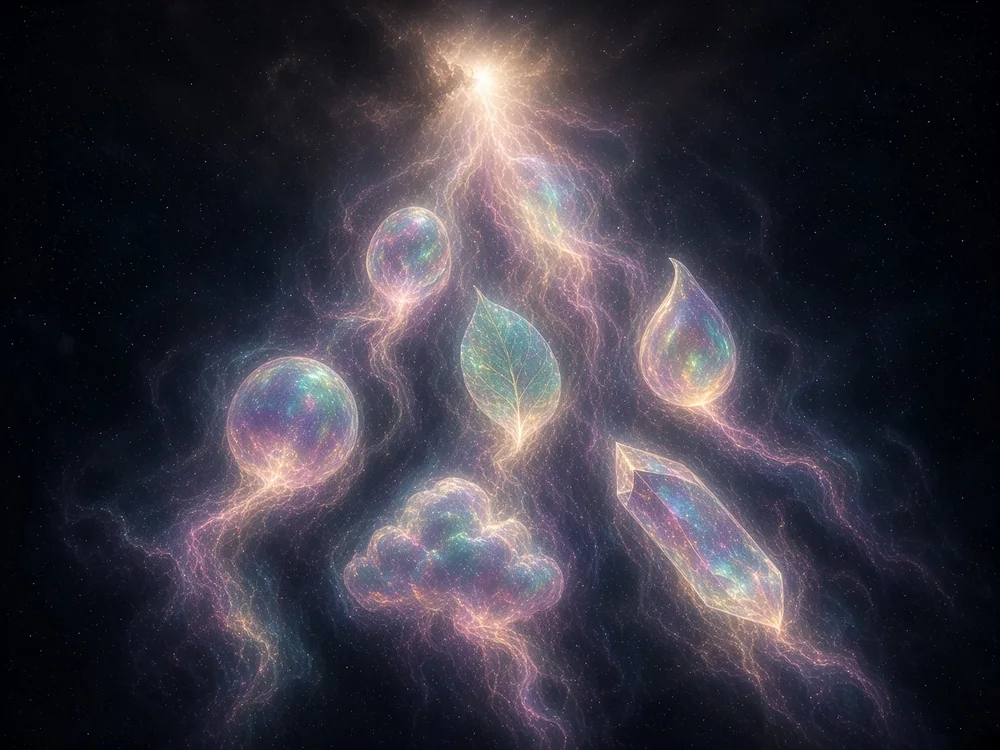
The same light, through a shape only you have.
- The big idea
- You show the light in your own shape, and your shape is enough.
- What’s hard to get
- This is not fatalism. It is accuracy: you can only grow as the thing you are.
- Common misconception
- That accepting your shape means you stop growing. An oak still grows. It grows as an oak.
- Why it matters
- Comparison grows quiet once you see that your window was meant to be yours.
Try it now
Privately, write three things that are simply true about how you are made. Not good, not bad, only true: I need quiet to think. I feel things late. I love to mend what is broken. Read them back as facts about a window, not faults in a person.
Go deeper
5 short sections. Open any one; each stands on its own.
1You never see the mirror1 min
When you look in a mirror, what do you see? Your face. Have you ever seen the mirror itself, while it shows you your face? Ibn Arabi says no, and builds a whole teaching on it:
"So the one shown saw only his own form in the mirror of the Real. He did not see the Real, and cannot, though he knows he saw his form only in it." (Fus. 61, Shīth)
Every time you truly see yourself, you are seeing by a light you can't see directly. Your self-knowledge is never only about you. It is always also a quiet glimpse of what holds the mirror.
2Each part thinks it's the most important1 min
In the Fuṣūṣ he pictures the whole cosmos as one great person, "the big human" (الإنسان الكبير). The angels are like its inner powers, and each power has the same problem:
"Each of those powers is veiled by itself, and sees nothing better than itself." (Fus. 49, Ādam)
You may know this from the inside. The worrying part of you thinks worry is in charge. The planning part thinks the plan is everything. Adam, in his telling, is the one who gathers all these powers and is veiled by none: the whole person, not the loudest part (Fus. 49; paraphrase). Knowing yourself begins with noticing which part is talking right now.
3Two honest answers1 min
"Whoever knows himself knows his Lord." Ibn Arabi reads it two ways, and both are kind:
"The first: that you know you do not know yourself, so you do not know your Lord. The second: that you know yourself, so you know your Lord." (Fus. 215, Muḥammad)
On days when you feel a stranger to yourself, that, too, is a kind of knowing: the self is too deep to finish, and so is its source. On days when something clicks, that click is a small knowing of the Real. Either way, you are on the path.
4Complete is not the same as better1 min
He calls the complete human "the most complete form that has appeared among existing things" (الإنسان الكامل أكمل نشأة ظهرت في الموجودات, Fut. I.163, ch. 17). Then he adds a line that takes the pressure off:
"But it does not follow that he is the best in the sight of the Real." (Fut. I.163, ch. 17)
The human is complete because he gathers everything, not because he outranks everything. Being whole is not about winning. A sky is not worse than you, and you are not a trophy. You are simply the place where all the pieces meet.
5Two missing bricks1 min
The Kaaba dream on the life page has a detail worth slowing down for. In Mecca he saw the Kaaba built of gold and silver bricks, with two missing: one gold, one silver. Then:
"I saw myself pressed into the place of those two bricks … and I was standing, looking, and knew I was standing, and knew I was those two bricks." (Fut. I.319, ch. 65)
Both at once: the one watching and the piece that fits. Knowing yourself can feel like that. You are a person looking, and you are also a shape the whole was waiting for.
Generations later, ʿAbd al-Karīm al-Jīlī wrote a whole book called al-Insān al-kāmil, the Complete Human, carrying this idea forward.
Key words
This page is a closer look inside Chapter 8.
Back to Chapter 8: The Perfect Human →Course homeSources
- Ibn ʿArabī, Fuṣūṣ al-ḥikam; trans. R. W. J. Austin, The Bezels of Wisdom (1980) (the chapters of Adam and Muḥammad)
- Ibn ʿArabī, al-Futūḥāt al-Makkiyya, ch. 17 and ch. 146
- William C. Chittick, The Sufi Path of Knowledge (1989), ch. 1
- Masataka Takeshita, Ibn ʿArabī’s Theory of the Perfect Man (1987)
- Ibn ʿArabī, Fuṣūṣ al-ḥikam, ed. Afifi, Ādam (p. 49), Shīth (p. 61), Muḥammad (p. 215)
- Ibn ʿArabī, al-Futūḥāt al-Makkiyya, ch. 17 (I.163), ch. 65 (I.319)
- ʿAbd al-Karīm al-Jīlī, al-Insān al-kāmil
- Michel Chodkiewicz, Seal of the Saints (1993)
- William C. Chittick, The Sufi Path of Knowledge (1989)